Monday, 29 June 2015

The amazing Partnach Gorge

We had the most wonderful experience today walking through the Partnach Gorge! We took the train to Garmisch-Partenkirchen and then had quite a long walk through the town to the Olympic Ski Stadium and then, on pretty mountain trails, to the mountain hamlet of Vordergraseck. The Partnachlamm (or Partnach Gorge) commences there and we entered through a series of low tunnels cut in the rock. The noise of the water roaring through the ravine below is deafening and you need to be careful on the narrow pathway above. There was a continuous file of people, with some waiting patiently while others took photos. In some places there was a mist of water with the sun shining through; in others the water surged through the gorge with astonishing power. It was a beautiful and thrilling experience to be there!

We emerged from a tunnel to this narrow ledge.
It was really narrow here!
We could see the power of the water caught between the walls of the gorge.

A dazzling rainbow of spray
The river at the top of  the gorge
The gorge walk took about 45 minutes and then there was a hard uphill walk through the forest to return to Vordergraseck. From there we took a horse-drawn carriage ride back to the Ski Stadium and walked into the town. We stopped at an Italian restaurant for a much-needed rest and a late lunch before the train trip back to Augsburg.


Views from the town - still some snow on the mountains.


Sunday, 28 June 2015

A Walk in Augsburg

Sunday 28 June: We caught an early train from Nuremburg and arrived in Augsburg about 8.30am. It was a short walk to our apartment where we were met by the owner, Claus, who lives upstairs. We are staying in the ground floor of a 16th century house which has been beautifully renovated by Claus who is an architect.


Garden views from our windows
Unfortunately the internet connection is very slow here and that, coupled with the fact that the jigger I use to download photos from our cameras seems to have died, means that I am afraid there will be very few photos in the blog from now on. (In  fact the connection is so slow I couldn't post this last night but now at 5.30am I can! If there is no post from now on, that will be the reason.)

Once we had unpacked, we set out on an Augsburg city walk. The first stop was Fugger House, a huge mansion stretching for a good part of a city block, which was the town residence of one of the wealthiest families in Europe. Jakob Fugger (1459 - 1525) was the son of a merchant family who became a hugely rich financier, lending money to the rulers of Europe, including Emperor Charles V.

Next we visited the Schaezler Palace, which incorporates the State Gallery, where we saw paintings by Holbein the Elder and also the beautiful rococo ballroom where Marie-Antoinette danced one night on her way to France to marry Louis XVI.

From there we walked to the Fuggerei, the oldest social settlement in the world. Jakob Fugger founded this in 1521 for poor but deserving Catholic citizens of Augsburg. They were charged an annual rent of one Rhenish guilder (now 0.88 euros) and required to say three different prayers per day for Jakob and his family. There are now 140 apartments housing 150 people, still financed through the Fugger family endowment. It is a city within a city with its own church and city walls and gates. There is only one gate through which residents can enter after 10pm, where a night watchman will let them in for a small fee.

The Fuggerei was badly damaged by bombing in 1944/45 and, in its World War II air-raid shelter, there is an interesting display about its reconstruction. There is also a museum with a dwelling as it was in the 17th and 18th centuries and a 'model apartment' which shows the current lifestyle of residents.

After lunch at the Fuggerei, we walked back to the main street to the Perlachturm, a tall tower which was built in the 10th century and extended in the 17th century. I climbed the 260 steps to the top where I had a wonderful view over the city and beyond. It was 4pm when I reached the top, just below the bells, and the sound of the chiming was deafening!

On the way back to our apartment, we called in at St Ulrich and St Afra Church. These adjoining churches commemorate the 1555 Peace of Augsburg which recognised the Lutheran and Catholic denominations. Catholic St Afra church has three magnificent altars but there was a service in St Ulrich's so we couldn't look in there. It is just around the corner from us so there will be other opportunities.


The three magnificent altars in St Ulrich's Church


Saturday, 27 June 2015

Wurtzburg - a princely town

We travelled in a different direction today - Wurtzburg is an hour by train north-west of Nuremberg and on the Main River. It was raining all morning but that did not stop us from walking to the Old Town, taking photos of various interesting buildings around the Market Place and visiting the Marienkapelle (St Mary's Chapel).

Marienkapelle

Judgement Day: off to Hell for this lot!

The Falkenhaus
We arrived at the Residenz, a UNESCO World Heritage Site and the main attraction in Wurtzburg, in good time for the 11am tour in English, only to find that the Residenz was temporarily closed due to overcrowding. Luckily it was reopened to admit a Japanese tour group just before 11 and we managed to persuade the guard to let us in too for the tour.

We were led by a young university student who is training to be a teacher (history presumably) and who told us that this was good practice for him! He did a very good job and told the quite large group of English-speakers a lot of interesting information about the palace rooms that we visited.

Most of Wurtzburg was destroyed by bombing and fire in 1945, including the majority of the rooms of the Residenz, except the grand staircase and rooms nearby such as the White Hall and the Imperial Hall. This meant that the beautiful ceiling frescos by Giovanni Battista Tiepolo (1752/53) were saved and also much of the furnishings and the wall panelling, which had been removed to safety. Restoration was completed in 1987 and they have done a wonderful job! Unfortunately no photos were allowed so I have photographed a few postcards that we bought.


We spoke to our young guide about why Wurtzburg was bombed since there was no industry or other obvious target there. It seems that it was just a convenient location for the Allied bombers to release the bombs they had left after bombing a more valuable target. When the Americans took the city towards the end of the war, their commander put a lot of effort into helping the townsfolk protect the historic buildings that had survived and putting temporary roofs over the remaining areas of the Residenz to preserve what was left there.

We had a lovely lunch in the Residenz restaurant (rump steak with melted red onion, bean ragout and crispy fried potato slices for Ian and pike-perch fillets with crisp rosti and asparagus for me) then visited the Residenz Garden. This lovely area is free to the public and lots of people were enjoying the sunny afternoon there.


Time was getting on so we had to make a choice between visiting the Marienberg Fortress high on the hill above the town and the Dom St Kilian (St Kilian's Cathedral). The cathedral won (less effort required!). We admired the white and gold sanctuary and spent some time looking at the numerous statues of prince-bishops through the centuries, which were saved when the cathedral was totally destroyed in 1945.


The Dom is named after St Kilian who was one of three Irish monks who were martyred in Wurtzburg. How amazing is that! Irish monks in Germany!

Before making our way back to the station, we strolled down to the Alte Mainbrucke (Old  Main Bridge) where there was a most festive atmosphere. Wine was being sold by the glass from roadside stalls and people were enjoying themselves in the sun. There were statues of Wurtzburg saints and prince-bishops along the bridge and a lovely view across to the vineyards on the hills above the town. We bought icecreams and returned to the station where we caught the train back to Nuremberg, to pack for our move to Augsburg tomorrow.

Partying on a Saturday afternoon
The Ratskeller restaurant
Statue of master wood-carver Tilman Riemenschneider
on the Franconia Fountain
Goodness knows what this is - I just like weird statues!

Friday, 26 June 2015

A Germanic Parthenon

Today we visited the town of Regensburg, an hour by train south-east of Nuremberg and on the Danube.

The highlight for us was a cruise down the Danube to the Walhalla, a monument high on a hill and modelled on the Parthenon in Athens. It was built by King Ludwig I and completed in 1842, to house busts of 'laudable and distinguished' Germans. The term 'German' is wide enough to include such people as Catherine the Great of Russia (born in Germany) and the Anglo-Saxon King Alfred.

We had an interesting and relaxing hour's cruise to reach Walhalla and then a long climb up the hill, including 251 steps at the top (yes, we counted them!) to reach the monument. The marble hall is beautifully decorated with blue and gold stucco work and marble Grecian statues, as well as 127 busts of heroes.

Our boat
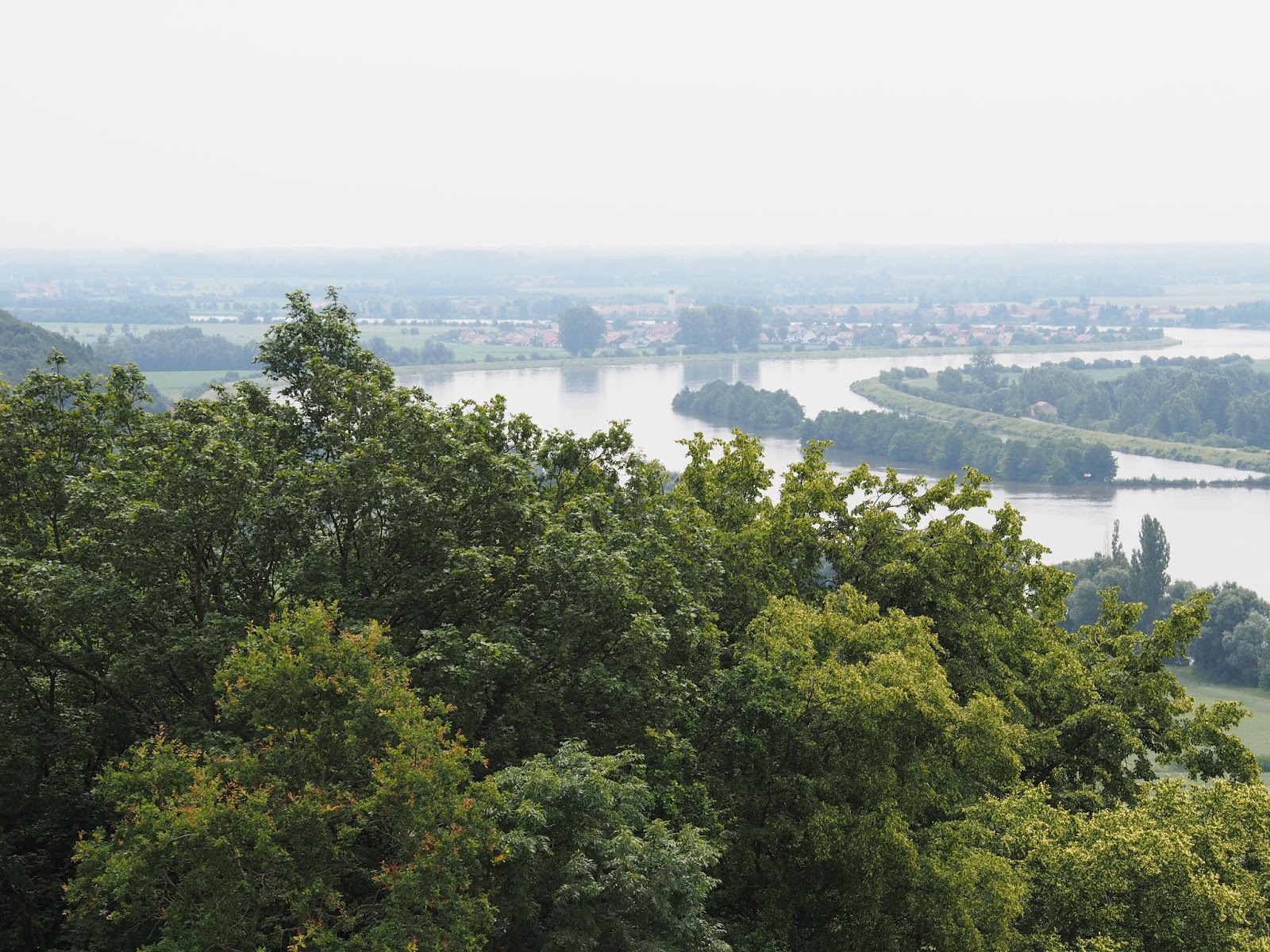
The view on the way to Walhalla


We also enjoyed the views from the top before making the descent back to the boat, where we had a picnic lunch on the way back to the city.
The view from the top
Two goats enjoying the view too
There are two sights for which Regensburg is famous: the Steinerne Brucke (Stone Bridge) which spans the Danube with sixteen arches, and St Peter's Cathedral, which has amazing stained glass windows and a couple of famous statues. We were somewhat disappointed to find the bridge covered in scaffolding and off limits, and the cathedral closed for the day.

Instead we spent some time at the Historical Museum and enjoyed an audio-guide tour of the Roman relics there. Regensburg began as a Roman legionary fortress known as Castra Regina in AD 179 and relics are still being found, including a hoard of gold and copper coins which is on display in the museum. The audio-guide, models and re-creations of different aspects of Roman life brought this period in Regensburg's history to life for us.

Recreation of rooms in a Roman house
A Roman tower incorporated into another building
A rather grand hotel in Regensburg
Cathedral spires


Thursday, 25 June 2015

Bamberg - another romantic medieval city

Bamberg is half an hour by train north-west of Nuremberg and , since it escaped the ravages of the Thirty Years War, the Reformation and the Second World War, its Old Town is virtually intact.

The highlight is the Altes Rathaus (Old Town Hall) which stands on an island in the middle of the Regnitz River. This location was chosen by the burghers in the 15th century apparently to demonstrate their independence from the prince-bishop who ruled the area.


Bamberg has several impressive churches but the most magnificent is the Kaiserdom (Imperial Cathedral) on a hill above the town. It holds the tomb of Holy Roman Emperor (and King of Germany) Heinrich II and his queen which was carved by Tilman Riemenschneider. There is also a statue of the mysterious Bamberg Knight and several beautifully carved altars.


We visited the Neue Residenz (New Residence), a Baroque palace which was constructed around 1700 for the Prince-Bishop. We were taken on a guided tour which was mainly in German but there were also some English notes for the bulk of those there who could not speak German.


Then we continued on to the adjoining Rose Garden, which was one of the prettiest gardens we have seen, with numerous beds of different coloured roses, statues dotted throughout and a wonderful view over the city.


Our final stop was the Naturkunde-Museum (Natural History Museum) where we visited the remarkable Bird Hall. This huge room houses a collection of animals and birds which was first established in 1791 by Prince-Bishop Franz Ludwig von Erthal and then continued by Father Dionysius Linder (1803) and later Andreas Haupt (1838-1885). The exhibition hall was renovated in 2009 to restore it to the original colour concept and it is now a beautiful white and blue panelled showcase for a fascinating collection.


The trip back on the train to Nuremberg at 4.30pm was an interesting one with a huge crowd on board. We managed to get seats but the aisles were jam-packed and a lot more people got on at the next station. I was afraid that the rather overweight man standing next to my seat was going to end up on my lap!

When we arrived back at our apartment, we noticed some police cars in our street and we were challenged by a few police in riot gear when we came close to our building. Luckily they let us through.


After about an hour it became apparent that there was a demonstration in the street around the corner from us and a little later, an opposing group set up across the road from us. The police seemed pretty relaxed but it all got pretty rowdy at times.


After about two noisy hours, it all suddenly ended and everyone went home. We used Googel Translate on some of the banner slogans and it seems it was something to do with freedom of opinion and the Islamic faith but we were not sure which group was in favour or against! A bit of excitement to end the day!